
An Interesting Journey
14 October 2026
No articles for a while, apologies. I am still working on my Limits of Machines book which is taking up much of the time I have for writing.
This was too interesting to let slip by without comment though.
With all the “AI” (or “SI” if you are one of Donald Trump’s special friends) hype around at the moment, and some pushback on many of the ridiculous claims being made, such as whether Anthropic’s Claude is “conscious” and how many psychologists they need to employ to track it’s welfare, the subject of whether machines can be conscious has become something of a hot topic amongst some fairly high-profile Smart People™.
Recently one of these Smart People™ posted an article titled “A theory of consciousness deriving spacetime” (link here). At first glance the TL;DR of this article seems very sensible and in isolation I would completely agree with it…
…it probably means that AI will never be a true threat as a god, of sorts.
Yes, correct. It most definitely will never be a “true threat as a god”.
I am not quite sure I agree as wholeheartedly with the venerated and quoted Dr Hoffman who says “that our everyday experience of reality is a useful evolutionary illusion rather than a direct window onto the world”, but he’s allowed his opinion as are we all. The article’s author seems quite sold on the ideas Hoffman espouses, and appears to consider his attempts to build a “mathematical model of consciousness” as something that could explain consciousness. As the article says he…
has used that model to offer a formal solution to the “combination problem” of consciousness. In other words, he’s used math to explain how a bunch of conscious agents combine and fuse into a unified “you”. He would claim that there is a layer of software outside of spacetime, and agrees with theoretical physicist John Archibald Wheeler that “There is no such thing at the microscopic level as space or time or spacetime continuum”.
So you can’t see time under a microscope? I can get behind that idea if we mean see it as something physical. I doubt he is describing something quite as mundane and obvious as that, and so this feels more like a semantic argument to be honest, but I could be wrong.
There is also a quote from Wheeler that says “Nobody can be anybody without somebodies around.” which is interesting, implying that if there was no-one to observe you, you would cease to exist. That can’t be it though, right? He can’t mean that surely?
Wheeler is then quoted or paraphrased as saying that the Universe is made up of our choices and what we choose to measure, matters.
I would suggest the first part of that statement is incorrect. The universe is made up of what it is made up of, and humans can impact a very small amount of the matter that makes up the entire universe. To be clear I am not buying into or promoting the idea that humans make up such a small part of what to some people appears to be a vast universe which then means we are insignificant, or a worthless cosmic accident. There is a difference between understanding the value of something rare, and believing that small, rare things can affect literal universal changes. One demonstrates the recognition that the relative size of something is not necessarily proportional to its worth, and the other seems to show the typical hubris of what we are told in The Current Year is Science.
I do not know Mr Wheeler personally so perhaps he meant something else. An alternative explanation could be that our choices of how to interpret our observations of the universe creates an internal picture of the makeup of the universe that may differ from how it really is. That doesn’t sound very “scientific” though, and seems unlikely to be what is meant.
The author then says…
What seems obviously true is that the observer participancy process is at the core of all science. Observer-participants generate information, information generates spacetime, and spacetime loops back to observer-participants. This is an infinite loop, and according to Hoffman, if we are to understand the role of the observer in terms of quantum theory, the loop must be “cracked”.
This seems to clarify that actual, reliable observation is important. Whether it truly is “at the core of all science” is certainly debatable, but it should be, and is part of the definition of what we know as the “scientific method”.
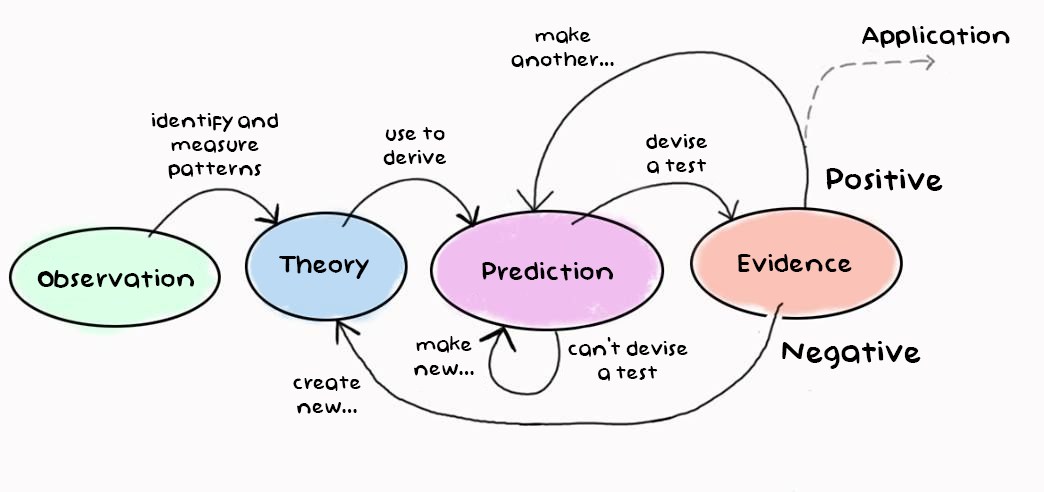
We actually have observation in two key stages of this method. Clearly as labelled we start off with an observation, something we wish to understand, explain, establish causality of etc. We then theorise, make a testable prediction based on that theory and then we check the evidence, which also requires as precise an observation as we can manage.
There are limits to our ability to observe. This is not a science lesson so I will not labour the point. It is quite well understood by almost everyone that when we try and measure or examine something extremely large or extremely small there are physical limits that impact the precision with which we can do so. The realm of Science is not immune to this. They might have expensive lab equipment but they do not have tools made up of things smaller than protons, electrons, neutrons and atoms.
This is why in quantum mechanics there is a thing called a “wave function” which is not a physical wave, but a mathematical description of a probability that something is likely to be in a particular place or state. Indeed quantum mechanics is named as such because of the apparent quantisation of energy and matter, which in other words means that they appear in discrete packets rather than continuous streams.
I have always wondered if this was more an artefact of the process and limitation of taking multiple measurements. By that I mean any measurement taken of a position or speed is a snapshot of whatever is being measured at that precise moment. Any subsequent measurement is just another snapshot and therefore by definition is not continuous. Performing many measurements with as small an interval as we could physically manage is still not continuous, just from a distance it kind of looks like it. To illustrate the point the images on our TVs are not actually continuous. There are enough single frames displayed in quick enough succession to make it look like that.
I am by no means suggesting I am debunking Max Planck and Albert Einstein here, but it is a real limitation regardless of how Planck’s Constant and the idea of energy radiated and absorbed in units called quanta fixed the maths. A topic perhaps for another article.
The point here is that there are definite, well established limits to which the precision of observation is confined, and whether you’d leave your pet cat with Mr Schrödinger is not the debate we’re having. Werner Heisenberg’s uncertainty principle has undergone a few revisions since it was formulated in 1927, most notably by Masanao Ozawa in 2003 which accurately describes uncertainty with respects to intrinsic statistical errors and measurement inaccuracies. It is a fairly non-contentious statement then to say that precise measurement of even physical particles is not possible, and we need to fall back on approximations, probabilities and interpretations where even movement is described as quantised steps rather than smooth continuous movement regardless of how we experience it.
Let us extricate ourselves from this quantum rabbit-hole for now, and get back to the main point of this article.
The author continues to describe various points about observers and then suggests…
…I find it too tempting to wonder of the observer stays in superposition. In other words, if the Schrödinger equation applies to everything (including observers), then there would be no collapse to a single outcome, and by extension, reality would never settle on a single definite outcome. So all possibilities remain real.
What is being referred to as “real” here? It is phrased as a what if, but this extraordinary notion of all things happening and all possibilities being real does not seem to be a rational conclusion even if we take the main tenets of quantum mechanics at face value. What could possibly motivate someone who is clearly not stupid, to read the outputs of two, also non-stupid people (Hoffman and Wheeler) and head in the direction where all outcomes of everything are real?
We get some more sensible text where the author explains the difficulty of deriving consciousness from what is essentially materialist physics. No argument from me there. After this is where the language and word choices in the article and quoted from Hoffman get more interesting and we appear to be on some kind of journey.
We get this sentence…
Let’s say that a conscious experience can be described using a Markov matrix, where each matrix represents conscious observer.
This is presumably a thought experiment, and so yes technically we could “describe” or encode the description of a conscious experience with a Markov matrix, but of course no description of anything is the same as the actual thing itself, which is why people regularly append the words “you had to be there” after their description of an event, place or experience fails to have the expected or hoped-for impact on the listener.
The author continues:
Think of it like this: each conscious experience – like the smell of petrichor – together with the chances that it will turn into any other feeling – like sadness – can be described by a matrix of any size. This matrix is a fixed transition matrix and it is thought to be the inherent start point of a conscious agent. It is a fixed rule that governs transitions between experiences and not derived from anything more basic.
I will have to think about what that means. Sounds like God to me.
Owen Wilson says “Wow”.
Okay so not a thought experiment then. To be clear, a Markov matrix is a step in a sequence of steps in a Markov chain. The matrix is a grid of numbers that describe how a state will change into a different state. The general idea of a Markov chain is that to predict the next state you only need the current state and to multiply it by the matrix that holds the rules. This means looking at and evaluating previous states is not necessary. In fact the point is you don’t even need to store the previous history.
A simple example would be a world with only two possible types or states of weather, sunny and rainy. We have those two states and these two rules:
- If it is sunny today, there is an 80% chance it will be sunny tomorrow, and a 20% chance of rain.
- If it is raining today, there is a 60% chance it will rain again tomorrow, and a 40% chance it will be sunny.
The Markov matrix is then set up using two more key rules…
- All entries in the matrix represent some probability that is not zero.
- Each row totals 1, where we are representing 100% as 1, and anything less as a decimal fraction.
Our matrix rules in this case looks like this:
| Sunny | Rainy | |
| From Sunny | 0.8 | 0.2 |
| From Rainy | 0.4 | 0.6 |
Our possible states are the top line. So if it is sunny, then the row “From Sunny” gives us 0.8 or 80% the next state is sunny and 0.2 or 20% it will be rainy. If it is currently rainy then there is a 0.4 chance, or 40% chance it will then end up sunny, and a 0.6 or 60% chance it will be rainy.
You can then track the probabilities forward, and as the state is updated by simply multiplying it by the matrix, you can derive the next state only needing the current one. For example…
In our representations of our state (1 row) and our matrix (2 rows) we we’ll refer to the left-hand side number in a row as element A and the right-hand side number as element B.
Day 1 (now) it is sunny, so that means the actual value for sunny is 1, and rainy is 0, these are our starting conditions, so our state looks like this:
[ 1 0 ]
…where the element A represents the chances of it being sunny and element B is the chance of rain. So it is currently 100% sunny and 0% rainy.
Day 2 we multiply our state (above) by the following matrix:
[ 0.8 0.2 ]
[ 0.4 0.6 ]
Our sums are:
For element A (the probability it will be sunny):
1 × 0.8 + 0 × 0.4 = 0.8
For element B (the probability it will be raining):
1 × 0.2 + 0 × 0.6 = 0.2
…and our state ends up as:
[ 0.8 0.2 ]
This matches the description of our rules where if it starts off sunny there is an 80% chance the next day will be sunny. Our 1 in element A represents it was sunny, and the 0 in element B represents it was not raining. For element A in the next probability state for sunny weather we take the value of element A in our current state, in this case 1, and multiply it with our “From Sunny” row element A which is 0.8 and we add that to the result of element B of our state which is 0 multiplied by element A of our “From Rainy” row which is 0.4 and the result of that once again looks like this:
1 × 0.8 + 0 × 0.4 = 0.8
We complete the matrix multiplication by also working out our new element B for our state (the chances of rain) by multiplying element A of our current state which is 1 by element B of our “From Sunny” row, which is 0.2 and then adding that to the result of element B of our current state multiplied by element B of our “From Rainy” row which is 0.6 and so we end up with:
1 × 0.2 + 0 × 0.6 = 0.2
The next state is calculated the same way, where we multiply our state which is now:
[ 0.8 0.2 ]
…by our matrix. The sums are then:
State element A = 0.8 × 0.8 + 0.2 × 0.4 = 0.72
State element B = 0.8 × 0.2 + 0.2 × 0.6 = 0.28
…and our new state is then:
[ 0.72 0.28 ]
You can continue to calculate the next state only needing the current state and the matrix which represents the rules.
Markov chains and matrices are interesting. They were invented by Andrey Markov in 1906. Should we be using them for weather forecasting? Obviously not for several reasons. Firstly this was just an example of what they are and how they work. Secondly these numbers can eventually converge, and you end up with what is known as a “steady state” where performing the multiplication of the state by the matrix gives you the same values. Our sunny/rainy example would eventually end up looking like this:
[ 0.667 0.333 ]
…or two thirds and one third and the speed at which this occurs depends on a few factors related to the matrix. In our tiny example by day 6 the values are virtually indistinguishable from the fully converged values.
Why are we talking about any of this stuff? Oh yes, our esteemed author thinks that we can describe conscious experiences with matrices and that the chances of changes in feelings can also be described “by a matrix of any size” and that it is a “fixed transition matrix and it is thought to be the inherent start point of a conscious agent”. More interesting language.
This is all supposed to (potentially) prove that spacetime can be derived from “the theory of conscious observers/agents”, and not the other way around. Again, I am all for the idea that consciousness does not magically spawn from mere arrangement of matter, but this all seems rather strange. We’re trying to prove that AI can’t become conscious because it is just a construct of the physical world, but to prove this we are modelling consciousness on a mechanistic mathematical framework without even explaining how a description of the thing is not the thing itself and so why any of this is even relevant. A three dimensional computer model representation of a house can look very realistic, but it is not the house itself, and there we are just considering a non-conscious, non-alive object.
We get some more blurb about conscious agents, matrix transitions and so on, nothing that seems to actually map onto reality as we experience it, individually and collectively. I am making no claims as to having all the answers, and I am not criticising exploration and the desire to understand. Sometimes though I do wonder at the directions some of these enquires go, especially when they go in the direction this author is going, and by that we get some paragraphs and AI generated images about Donald Hoffman’s Conscious Agent Hierarchy and this interesting paragraph…
Each conscious experience depends on what your matrix is. Yours might be much higher in dimensions than mine which means that you would experience things completely differently from me. We might be looking at the same thing but we won’t see the same thing. It would be the difference between not believing that certain things are possible and knowing that they are. It all depends on the dimension of the matrix that the conscious agent resides in.
Now you might think that all this talk about higher dimension consciousness sounds a bit woo-woo. Clearly we have some overlap with the terminology used in matrix multiplications and multi-dimensional arrays storing states and data, with this now commonly used word “agent” that has been hammered into public discourse by “AI” companies and their doom-trolling marketing, and now the idea of multiple agents of consciousness described by Markov matrices. I would like to assure you that there is no woo-woo going on, but alas we get to a crucial point in the article where reading it you become aware that the idea of how we are each trapped inside a metaphorical VR headset where the author suggests we should be looking to outgrow or even remove this headset and transcend sounds somewhat familiar.
No need to guess, she helpfully informs us that:
This is pure Gnosticism
…and:
In my view, we are transcendent light beings and according to Hoffman, we are wearing VR headsets that hide us from reality. I can’t say that this challenges my view.
So what is Gnosticism? It is described online as a collection of diverse religious and philosophical movements that flourished in the first to fifth centuries, most notably characterised by the belief that salvation is achieved through gnosis, or esoteric, direct knowledge of the divine.
They believe in what is termed a “Dualistic Cosmology” where the material world is inherently bad, created by an evil or malevolent deity known as the Demiurge and often identified as the God of the Old Testament in the Christian Bible, who is according to them distinct from a transcendent supreme true God.
Yes, we’re back to “my god is better than your god” stuff. And you thought this was science right?
Gnostics also believe that humans contain a fragment of divine light trapped in their physical bodies, and the whole plan is to have revealed to you the secret knowledge that you need to liberate you from this material world.
There are not many well known people that officially declare they are Gnostic believers, mostly due to the fact that Gnostic churches like Ordo Templi Orientis for example keep quite a low profile.
We arrive at a point in this journey where we find out that Gnosticism connects in multiple ways to Aleister Crowley of all people. Crowley for those unfamiliar was considered a controversial figure in his day, as his lifestyle choices in the late 1800s and early 1900s were somewhat less fashionable than they would be today. He deliberately cultivated a provocative and distasteful persona, founded Thelema which is a religious philosophy (I know) that had the following statement as its central principle:
Do what thou wilt shall be the whole of the law.
Crowley was a member of the Ordo Templi Orientis and he restructured it around Thelema, and was consecrated a Gnostic bishop. Thelema shares a number of key features with classical Gnosticism, although he considered the material world to be the arena where one discovers and follows their True Will, which does diverge from the Gnostic view that the world needs to be escaped from. Crowley however by his own adage just did what he wanted to do, so we should not see his choices as any kind of indicator of genuine devotion to anything beyond his immediate desires and proclivities.
I am not suggesting the author of the article we are evaluating is some kind of Crowley-like character. But the interesting thing is this… There are thematic similarities to Gnosticism and the much more modern belief system of Transhumanism. For example:
- They both hold the view that the body is a prison. Gnosticism holds that the divine spark has been trapped in the fleshly body by the Demiurge, and Transhumanists like Nick Bostrom and Tim Cannon believe the body is a prison they are trapped in.
- Both of these belief systems describe a form of salvation where they leave their bodies and material existence behind. The Gnostics believe in their journey to Pleroma, by which they mean the totality of divine powers, and Transhumanists believe in uploading themselves or transcending into a post-biological state.
- They both hold that an enlightened few who possess the the secrets will transcend. Gnostics believe the revelation of secret knowledge will liberate them from their current state, and Transhumanists believe technological advances and science will liberate them.
- They also both treat the physical world and matter as inferior and to be cast aside, not as something good that can be redeemed in any way.
Transhumanism then seems like a more scientifically framed version of Gnosticism, a secularised version that is more acceptable in The Current Year, because we do not believe in magic men in the sky any more, especially if you are part of the scientific community as our author is. No she has not discussed Transhumanism in plain terms, but the door has certainly been cracked open.
Several people have already made the connection between Gnosticism and Transhumanism. Erik Davis wrote about this very thing in his 2015 book “Techgnosis: Myth, Magic, and Mysticism in the Age of Information”. To give you a flavour of the content (this is not a sales pitch) some of the chapter names are as follows:
- Imagining Technologies
- The Alchemical Fire
- The Gnostic Infonaut
- Techgnosis, American-Style
- The Spiritual Cyborg
- A Most Enchanting Machine
- Cyberspace: The Virtual Craft
- The Alien Call
- Datapocalypse
- Third Mind From The Sun
- The Path Is A Network
You get the idea. Jeffery Pugh wrote “The Disappearing Human: Gnostic Dreams in a Transhumanist World” in 2017 where he talks about how “The Gnostic desire to escape our embodiment found in transhumanism carries the danger of dissolving the human being.” and that “In seeking freedom from the constraints of nature, it resembles ancient Gnosticism, but complicates the question of what the human being is.”.
There has been some pushback from Transhumanists who make the distinction that they just want to choose what bodies they inhabit, rather than be constrained to their current ones. Generally though the basic premise is the same… they both (Gnostics and Transhumanists) wish to escape their current biological form because it is considered inferior.
The other main distinction between Gnosticism and Transhumanism that is used to distance one from the other is that the Gnostic’s means of escape is still an external God figure, whereas Transhumanists do not require any silly gods, because they are so smart they figured out the escape method themselves.
What this actually looks like is just a more grandiose version of Gnosticism where instead of needing the revelatory assistance of the supreme God, the super-smart Transhumanists become gods themselves. This is where Crowley’s hybrid version of Gnosticism seems more like a stepping stone towards the humans becoming gods Transhumanism we have now. Crowley’s core change to Gnosticism was how the individual becomes the agent of their own transcendence, with the “do as thou wilt” self-goodhood rejection of external divine authority, which is analogous to the process Transhumanism describes.
Gnosticism was seeking out the secret knowledge from the supreme God leading to transcendence, Crowley shifted to rituals, magic and psychic discipline to achieve it, and Transhumanism is all about engineering new technology, AI and the post-biological state.
There was much less tech around when Aleister Crowley was inventing his self-serving religion and flipping off the status quo. But it was a step towards the idea of humans becoming gods. Now we have prominent characters like Noah Yuval Harari officially making the divine revelator entirely redundant with phrases like…
Human history began when men created gods. It will end when men become gods.
Obviously this is all stupid. AI fans and Transhumanists will say I just don’t know what I am talking about, and Smart People™ generally will polish their credentials and continue believing things like the description of a consciously experienced event is the same as experiencing it.
Perhaps the author of the article we’ve looked at doesn’t quite get it, but I’m afraid it is hard to reconcile a supposed professional Science person who chides others for lack of evidence to support their claims (which is fair) literally talking about Gnosticism and what appears to be slow-walking the audience to the edges of Transhumanist beliefs.
It’s a strange time to be alive.